Fluffy white clouds against a blue sky

Our Blog

The Electric Toothbrush vs. Manual Debate

February 16th, 2017

Every now and then, in the halls of both of our St. Charles and Creve Coeur offices, we hear the echoes of an argument that we are so used to hearing it’s created its own beaten path in our hallways and in our minds.

In our offices, the twist on the debate comes in the form of what a child should be using to clean their teeth. So, in the debate of an electric toothbrush vs. manual, which one is better for your child? Let’s dive in.

The Electric Toothbrush vs. Manual Debate - Dentistry for Children & Adolescents

Fun fact: did you know the modern toothbrush came about at the turn of the 16th century when a Chinese emperor put hog bristles through a bone handle to help clean his teeth? It’s true!

The Fun Factor

Electric toothbrushes benefits from very nearly falling into the category of a fun toy for a child to play with as opposed to a device with more in common with a hair brush. Some even say it “tickles” their teeth, further

If your child is more enthusiastic about brushing their teeth when they have an electric model, then by all means let them go wild. They also benefit from being easier for kids to use as the toothbrush does a majority of the scrubbing so long as it is held at a proper angle (around 45 degrees).

Some advanced models even include a built-in timer so you know exactly how long they’ve been brushing. Remember, two minutes of vigorous brushing is optimal!

With all that said, electric toothbrushes tend to cost much more than their manual counterparts. They are also much more fragile, by comparison to manuals. Plus, if they aren’t charged they lose all the benefits mentioned above. And electric models tend to come equipped with heads that do not lend themselves easily to the linear motion of manual brushing.

Manual for All Modes

Manual toothbrushes are your simple, no-hassle argument against the complexity of electric models.

With proper technique, a manual toothbrush can be just as effective at cleaning teeth as an electric. With manuals, you also have more options to choose from in the form of softer bristles, head size, etc. They are easier to travel with comparatively, do not require charging or batteries, and are inexpensive.

Proper technique for children can be tricky, and without the timer of an electric they can leave a lot to be desired in their ability to clean their teeth effectively.

The Verdict?

Honestly, the verdict from us depends largely on your child. If they are more excited about keeping their teeth clean with an electric toothbrush, then let them use one. The cost of an electric model versus the cost of filled cavities and other various dental issues is miniscule.

Alternatively, if your child does well with a manual brush then you shouldn’t force them to use an electric model for no reason. Just ensure they are using proper technique and are brushing long enough to do a thorough job.

How to Remove a Loose Tooth for Your Child

February 16th, 2017

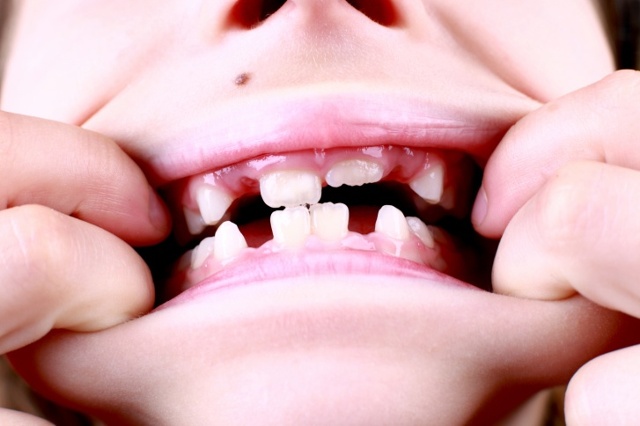
Everyone remembers losing their first tooth. The anticipation, the feeling of the tooth barely hanging on by a thread, perhaps you even remember tying it to a door and shutting it with your older sibling at the helm!

Your parents may have not approved of that method then, and as parents today you probably don’t approve of it now! So, what’s the best way to remove a loose tooth for your child? Let’s find out!

ThinkstockPhotos-471165848

When to expect a loose tooth

By the age of three, most children have all 20 of their primary teeth. At that point, the countdown begins to around the age of six-years-old when they will begin to loosen and fall out to make room for their permanent counterparts.

Teeth will fall out in the order they came in and your child should have lost all their primary teeth by the time they reach the age of 13. There is no rhyme or reason when they will fall out, but that broad timeframe is a reasonable expectation.

Most children are very excited to lose their baby teeth, thanks in no small part to the tooth fairy. The process of losing them is also much less painful than teething, which is good news for you as parents!

Removing a loose tooth

If your child has a loose tooth and keeps wiggling it around and messing with it, that’s okay! While waiting it out is the best choice, having your child play with the tooth will help make it even looser and expedite its detachment.

Some dentist’s warn against these methods though due to bleeding and the potential for infection, but the potential is minimal and the bleeding is nothing a little gauze can’t handle.

It’s also important to note that he or she should do the pulling. Only they can tell how truly loose it is. If you want to help, try having them bite into an apple! You may just find the tooth embedded in it afterward.

After the tooth has been removed, check to make sure the tooth didn’t fragment in the socket it left behind. If you see that it has, visit your pediatric dentist as soon as possible to have the situation assessed.

Other than that, it should be smooth sailing! As always, if you have any questions, please don’t hesitate to ask!

5 Reasons Kids Should Smile More!

February 16th, 2017

Salesmen will always teach you to sell the benefits, rather than the features, to a client. As a parent, you often face the same struggle with your children—“eat this because it’s good for you,” or perhaps, “do well in school so you can get into a good university.”

For parents who find it challenging to get their children into our offices, we know it might be a tough sell to get them excited about a dental check-up. In an effort to help out our dutiful parents, we’re going to give you our 5 reasons kids should smile more that will make it a little easier the next time you need to come in.

little girl holding a smile

5 Reasons Kids Should Smile More!

Your immune system gets a boost! When you smile, your body naturally relaxes and your immune system is able to function optimally in fighting off infections and common ailments.

It relieves stress. Stress can affect everyone—yes, even your kids! With the pressure of academics, extracurricular sports, and social pressures, it’s easy to see how full a young teen’s plate can get emotionally. Every smile releases endorphins and serotonin which are the main chemicals in our brains that boost our moods. Smiling increases the production of these, lowers the production of cortisol (the stress hormone) and helps lower heart rates as well!

People who smile more achieve more. Poor dental health has been linked to lower academic performances. This extends past our formative years, as smiles contribute to success in job interviews and promotions once hired on. Smiling exudes confidence and an ability to cope well with stress. Tell your child that going to the dentist is going to help them succeed!

Smiling is contagious! Studies have shown that seeing a person smile activates the area of the brain responsible for facial expression. The next time your child raises a fuss about going to the dentist, tell them it’s so they can make everyone in the room happy with their bright smile!

Smiling leads to making more friends! If you’re little one is having trouble getting motivated about a dentist appointment, tell them how smiling helps them make more friends! Tell them about how body language speaks volumes beyond the words we use. Ask, “who would you rather talk to: a person cheerfully smiling or a grim-faced person?”

Hopefully with these benefits ready to go at a moment’s notice, you’ll be more prepared for when your child needs to hear them the most!

Is my Child's Lisp a Dental Issue?

February 16th, 2017

Many children lisp, and whether you find it to be a cute trait or one that is cause for concern, you need to know what is the root of the issue. If your child is almost ready to enter pre-school, this issue can prove more problematic. So here you are, and you need to know—is my child's lisp a dental issue?

is my child's lisp a dental issue

4 Common Lisp Types

Lisping can be caused by a variety of reasons, but there are four common types of lisping that must first be identified.

When the tongue habitually protrudes between the upper and lower front teeth, replacing the ‘s’ and ‘z’ sounds with the ‘th’ sound, is known as an interdental or frontal lisp.

When the tongue pushes against the front teeth when producing the ‘s’ or ‘z’ sound, it is known as a dentalized lisp.

Both these types of lisps are considered normal for speech development in toddlers up to four years-old. Some experts go as far to say seven years-old is normal for a child to have a lisp.

lateral lisp is where air flows around the tongue when a child produces the ‘s’ or ‘z’ sounds, and a palatal lisp occurs when a child touches the roof of the mouth when producing those sounds. These two aren’t nearly as common as the former two, but deserve to be noted because of their differences.

Dental Professional Opinion Time!

What are the causes of these lisps? Tongue thrusting, thumb sucking, overly excessive pacifier use and bottle feeding can intensify the severity of your child’s lisp. A pediatrician can help determine if malocclusion from any of the prior listed habits are the source of the problem.

Additionally, they can check for things like allergies, nasal obstructions and enlarged tonsils which may contribute to the issue.

Sometimes, a speech-language pathologist can help if no specific cause can be found.

The Most Important Part

In any instance, being an encouraging factor in your child’s life will help immensely while you both continue to work through the issue. Reminding your child that it is not a defining characteristic of themselves and merely a problem to work through will be critical to their overall development as a person. And having a pediatrician and pediatric dentist on your side that will do the same through the process will help all that much more!